Brandon and Emma Search for Roseanne’s Hospital Records
Day of the DeadBrandon Walker and Emma Orozco’s search for Roseanne Orozco’s hospital records turns a decades-old absence into a new investigative lead. The records are supposed to establish who treated Roseanne during her July 1970 appendectomy; instead, the hospital’s denial that she was ever admitted conflicts with Emma’s surviving records and revives her suspicion that something happened inside the hospital. The search joins a mother’s long-delayed demand for answers to a broader question of who kept, controlled, and failed to act on the evidence of a crime on the reservation.
The Records and the Question
Brandon remembers that, in the early 1990s, a grant-supported study had placed existing health records from Sells Indian Health Services Hospital into a computer system. The study, associated with Arizona State University, was intended to compare Tohono O’odham longevity with that of other populations and to track which diseases accounted for deaths on the reservation. Records reached back to the 1950s. Along with money from tribal casino operations, the project had helped make a kidney dialysis center at the hospital possible. For Brandon, its practical investigative significance is more immediate: Roseanne’s appendectomy record from July 1970 ought to be retrievable with a few keystrokes.
Availability, however, is not the same as access. Brandon expects a request from him to meet polite resistance. As an outsider, he thinks the staff may look at his face, treat him respectfully, and still deny that such an old record exists. He therefore hopes Emma can obtain the information herself. The distinction matters to the investigation: the computer archive may preserve the past, but the ability to consult it remains shaped by who asks and how that person is received.
The search grows out of Emma’s decision to speak after years of holding back. When Brandon first met her, he avoided direct questioning, knowing that among the Tohono O’odham it could be considered impolite. Emma explains that her husband, Henry Orozco, had urged the family to forget the painful past. Now he is dead, and she wants to know what happened to her daughter. Her hesitation does not diminish her resolve: the word murder is difficult for her to say, but she has come to pursue the case and to ask for help.
Emma’s Visit and the Missing Entry
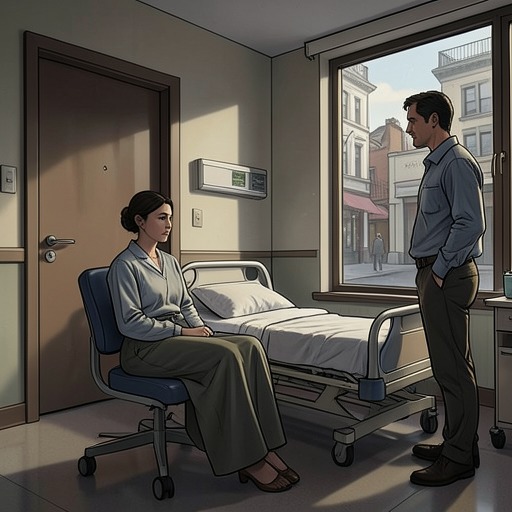
Brandon takes Emma to the hospital but chooses not to stand over her while she makes the request. He believes her chances will be better without a white man visibly pressing the clerk, so he waits by the entrance. The attempt at discretion does little to make him inconspicuous; people entering and leaving give him wary looks. From where he stands, he can see that the conversation is quiet and that the clerk types after Emma speaks. The clerk repeatedly pauses and shakes her head, leaving Brandon to infer that the requests are being refused.
At last, a new search produces a different response. The clerk smiles, prints several pages, and hands them to Emma. Outside the building, Emma explains the contradiction: the clerk says there is no record of Roseanne Orozco ever being admitted, suggesting that the old file may have been lost, but Emma’s own record confirms that she was in the hospital three times. It lists her stays for the births of Andrea and Roseanne and for her hysterectomy fifteen years earlier. The paperwork therefore does not simply fail to answer the question. It shows that the hospital retains Emma’s history while, according to the clerk, having no admission record for Roseanne.
Emma takes the discrepancy as evidence that someone at the hospital may have been involved. Brandon cautions that missing records alone do not establish what happened. Emma nevertheless connects the unexplained pregnancy to what she had heard about doctors mistreating patients. She remembers that such rumors surfaced after Roseanne was gone and that she wondered whether they might concern her daughter, but her husband had discouraged dwelling on the past. Her account turns the records search from a request for routine documentation into a focused line of inquiry: whether Roseanne’s pregnancy could have resulted from abuse while she was a patient.
From an Unanswered Question to a Lead
The search has limits. Emma cannot identify Roseanne’s doctor. She remembers that the doctors were young, that they stayed only a few years, and that they left after paying off college loans. Brandon responds that hospital records should show which doctors worked there and when. He asks when Roseanne was admitted so the period can be narrowed, making the missing patient record an obstacle rather than the end of the investigation. Emma’s memory supplies a time and a suspicion; the staff records, if they can be accessed, might supply names.
The reader also learns that the suspicion has a disturbing basis beyond rumor. Larry Stryker had been among a group of young doctors who abused female patients after administering sedatives. In Roseanne’s case, Larry’s use of a condom failed; he concealed what had happened, and a later pregnancy test was positive. Emma and Brandon do not uncover that explanation during their conversation, and the absent hospital entry does not prove it. The contrast between what the reader knows and what the investigators can establish gives the records search its tension: a concealed history exists, but identifying it through evidence remains necessary.
The investigation takes place against a history of uneven jurisdiction and neglected reservation homicides. Roseanne was believed to have been killed on the reservation, so the case fell outside the ordinary authority of the Pima County Sheriff’s Department and was left to federal or tribal investigators. Brandon remembers that the Tribal Police Force lacked training, equipment, and money, while FBI investigations into reservation murders were often cursory. This context does not itself explain the missing hospital record, but it clarifies why the original investigation produced so little and why Emma’s private recollection must now do work that official inquiry failed to do.
Consequences and Significance
Brandon treats the possibility of hospital abuse cautiously. He tells Emma that the theory may lead nowhere, but that it gives them a place to start, and asks again whether she remembers the doctor’s name. She does not. He then turns toward the hospital’s staffing records as a possible way to identify the young physicians who worked there during Roseanne’s admission. The search thus changes the scope of the case: instead of asking only who killed Roseanne, it asks what happened before her death and whether a hospital employee had access to her while she was vulnerable.
Emma’s role is not merely to provide information for Brandon’s investigation. She sets the inquiry in motion, insists that the missing record is wrong, and links the unexplained pregnancy to what she has heard about doctors. Brandon’s restraint—waiting while she speaks to the clerk, then cautioning her against treating suspicion as proof—makes their work collaborative without erasing their different positions. He brings investigative knowledge; she brings a mother’s memory and authority over the family history that had been suppressed.
The search also leads toward a difficult evidentiary decision. In a later effort to establish the identity of Roseanne’s unborn child, Emma has Sam Tashquinth and her grandson exhume the remains after dark rather than wait for permission from the tribal council. That action is not a result the hospital papers resolve, and it complicates the effort to make evidence usable in court. It shows the pressure created by the same delay and uncertainty that shape the records search: Emma seeks answers and a testable lead, while Brandon must consider both the needs of the family and the integrity of any evidence. The episode’s decisive outcome is therefore not a solved case, but a new, specific route into it—one that runs from a disputed hospital record to the doctors who may have treated Roseanne.